
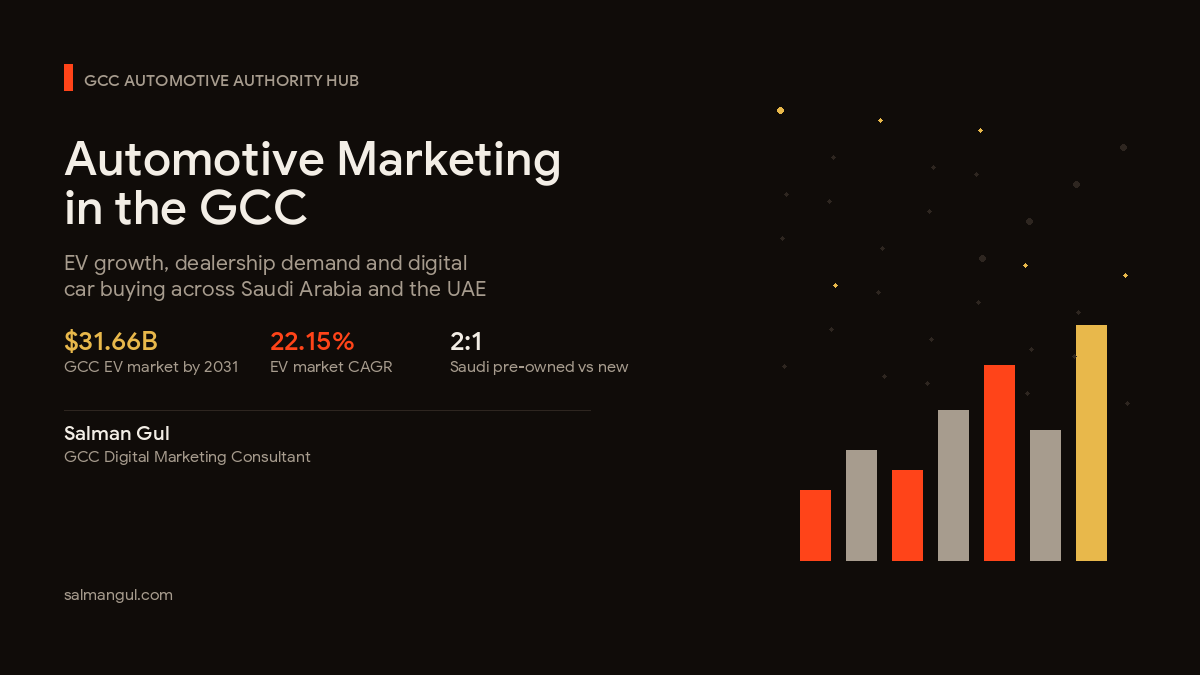
Automotive Marketing in the GCC
GCC automotive marketing
Digital, ecommerce and performance marketing for automotive brands in the GCC
The GCC’s EV market is growing nearly seven times faster than the region’s overall automotive market, and buyers are researching, comparing and increasingly even booking cars online well before they ever visit a showroom in Saudi Arabia or the UAE. Here is the market data and the digital playbook behind it.
$31.66BGCC electric vehicle market forecast by 2031, up from $11.64B in 2026
1.5Mlight vehicles sold across the GCC in 2025
2:1Saudi pre-owned car sales versus new car sales
42%share of the GCC EV market held by the UAE in 2025
The market
The GCC’s EV market is outrunning its own automotive market seven to one.
Vision 2030 electrification quotas, sovereign capital and a genuinely digital-first buyer are converging on the same shift: how a GCC automotive brand is discovered, researched and financed increasingly happens online, long before a test drive. Here is the scale of that shift.
Chart 1
GCC electric vehicle market size, 2026 to 2031 (USD billion)
Source: Mordor Intelligence, GCC Electric Vehicle Market (2026-2031, 22.15% CAGR). 2028 and 2029 are CAGR-interpolated indicative years.
Chart 2
Middle East automotive market size, 2025 to 2034 (USD billion)
Source: Market Data Forecast, Middle East Automotive Market (2026-2034, 3.21% CAGR).
Three numbers frame the opportunity. The wider Middle East automotive market is worth roughly USD 116 billion in 2025, growing at a modest 3.21% CAGR toward USD 154 billion by 2034. Sitting inside that market, and growing more than six times faster, the GCC’s electric vehicle segment alone is forecast to nearly triple from USD 11.64 billion in 2026 to USD 31.66 billion by 2031, a 22.15% CAGR. Saudi Arabia’s pre-owned car market already outsells new cars two to one, and the UAE, which held 42% of the GCC’s EV market in 2025 on the strength of more than 3,000 public charging stations, is expected to be overtaken by Saudi Arabia’s faster growth path by 2031.
Country by country
Where the volume and the EV growth actually sit
| Market | Position in 2026 | What is driving it |
|---|---|---|
| Saudi Arabia | Largest overall market, ~28.3% of Middle East share | 670,000+ new registrations, Vision 2030 manufacturing push, PIF-backed Lucid and Ceer, 2:1 pre-owned to new ratio |
| UAE | EV adoption leader, 42% of GCC EV market (2025) | 3,000+ charging stations, free Salik toll access for EVs, dense Sheikh Zayed Road showroom cluster |
| Qatar, Kuwait, Oman, Bahrain | Smaller but expanding steadily | Following Saudi and UAE policy signals, rising organised dealership investment |
Sources: Mordor Intelligence GCC Electric Vehicle Market and Middle East and Africa Automotive Electric Vehicle Market reports; Market Data Forecast Middle East Automotive Market report (2026); Frost & Sullivan GCC Automotive Growth Opportunities 2026.
The category
What is reshaping GCC automotive
Two forces are converging on the same buyer journey: government-backed electrification is compressing the adoption curve for EVs specifically, while the entire car-buying journey, EV or not, is shifting decisively online before a single showroom visit happens.
Force 01
The EV Acceleration
Vision 2030 quotas, a ten-year Saudi government commitment to purchase up to 100,000 Lucid vehicles, and dense UAE charging infrastructure are compressing the EV adoption curve far faster than the wider auto market is moving.
GCC EV market growing at 22.15% CAGR through 2031
See the roadmap →
Force 02
The Digital-First Car Buyer
Research, comparison, financing and even reservation increasingly happen online before a GCC buyer ever visits a showroom, and the pre-owned market, already outselling new cars in Saudi Arabia, is digitising fastest of all.
Saudi pre-owned car sales already outsell new cars two to one
See the roadmap →
The global landscape
The brands actually competing for the GCC buyer
Understanding who a GCC automotive marketer is actually competing against starts globally. By global sales volume, the world’s leading electric-vehicle brands in 2026 are led by BYD, now the world’s largest EV maker by volume, followed by Tesla, still the most valuable EV company by market capitalisation and the leading pure-battery-electric brand by volume. Behind them sit Volkswagen Group, spanning Audi, Porsche and Skoda, Geely Group, spanning Volvo, Zeekr and Lynk & Co, BMW, Mercedes-Benz, Toyota, Hyundai, Kia and Nissan, with fast-rising Chinese challengers including NIO, Li Auto, Xiaomi and Chery pushing hard from behind. Chinese automakers now supply roughly 60% of global electric car sales, a structural shift most Western automotive coverage still understates.
On overall global sales, spanning both combustion and electric lineups, Toyota remains the world’s best-selling automaker at roughly 12.6% global share, ahead of Volkswagen Group at approximately 9.4%. Rounding out the traditional volume leaders are Hyundai Motor Company, General Motors, Stellantis, spanning Jeep, Ram, Peugeot, Fiat and Citroën, Ford Motor Company, Honda, Nissan, Suzuki and Renault Group, the established, high-volume manufacturers whose dealership networks and franchise structures still anchor most GCC showrooms today even as their own electrification programmes accelerate.
EV infrastructure
The EV race is a sovereign-capital race
Saudi Arabia’s Public Investment Fund holds a majority stake in Lucid Motors and has backed a ten-year government commitment to purchase up to 100,000 Lucid vehicles, compressing an adoption curve that would otherwise take years into a matter of a single procurement decision. The Kingdom’s own EV brand, Ceer, is targeting an USD 8 billion contribution to Saudi GDP by 2034, part of a broader push to position Saudi Arabia as a regional automotive manufacturing hub under Vision 2030, alongside a mandate that 30% of Riyadh’s vehicles run on electric power by 2030.
The UAE has taken the infrastructure-first route, building more than 3,000 public charging stations concentrated around Dubai and Abu Dhabi, offering free Salik toll access specifically for EV owners, and targeting a 50% electric-vehicle mix nationally by 2050. Medium and heavy commercial vehicles are forecast to be the fastest-growing EV category through 2031, as fleet operators, taxis, buses and municipal services electrify ahead of the wider consumer market, a segment most GCC automotive marketers still underserve relative to the passenger-vehicle focus dominating current campaigns.
The library
The automotive marketing playbooks
This hub grows into a full library of automotive-specific marketing playbooks, each built on the same standard as the rest of this site: real data, worked context, and execution you can actually use.
Who is writing this
Over a decade inside GCC digital and performance marketing
I am Salman Gul. For over a decade I have run digital and performance marketing across the GCC, covering paid media, performance, CRM and retention across consumer categories with the same high-consideration, multi-touchpoint purchase journey that defines automotive, applied to real budgets and real showroom and online sales targets.
10+ yrs
in GCC digital and performance marketing across high-consideration purchase categories.
4 yrs
running GCC ecommerce, sales and retail operations end to end.
Full funnel
paid media, performance, CRM, retention, merchandising and conversion.
Data-led
every decision tied to lead quality, cost per sale and true dealership economics.
Questions
GCC automotive market FAQs
How big is the GCC automotive and EV market?
The wider Middle East automotive market is worth roughly USD 116 billion in 2025, growing at a modest 3.21% CAGR toward USD 154 billion by 2034. The GCC’s electric vehicle segment specifically is forecast to nearly triple from USD 11.64 billion in 2026 to USD 31.66 billion by 2031, a 22.15% CAGR, growing more than six times faster than the overall automotive market around it.
Which country leads GCC EV adoption?
The UAE held 42% of the GCC EV market in 2025, built on more than 3,000 public charging stations and free Salik toll access for EV owners. Saudi Arabia is projected to overtake the UAE by 2031 on a faster growth path, powered by Vision 2030’s electrification mandates, Public Investment Fund backing for Lucid Motors, and the Kingdom’s own Ceer EV brand.
Who are the top EV brands competing for GCC buyers?
BYD is now the world’s largest EV maker by sales volume, followed by Tesla, the leading pure-battery-electric brand and most valuable EV company by market capitalisation. Volkswagen Group, Geely Group, BMW, Mercedes-Benz, Toyota, Hyundai, Kia and Nissan round out the leading global EV brands, with Chinese automakers now supplying roughly 60% of global electric car sales.
Who are the top traditional automotive brands by overall global sales?
Toyota remains the world’s best-selling automaker at roughly 12.6% global share, ahead of Volkswagen Group at approximately 9.4%. Hyundai Motor Company, General Motors, Stellantis, Ford Motor Company, Honda, Nissan, Suzuki and Renault Group round out the traditional volume leaders whose dealership and franchise networks still anchor most GCC showrooms today.
Why does the pre-owned car market matter so much in the GCC?
Because in Saudi Arabia specifically, pre-owned car sales already outsell new cars two to one, and this segment is digitising rapidly alongside new-car ecommerce. A GCC automotive marketing strategy that only addresses new-vehicle sales is ignoring the larger and faster-growing half of the actual car-buying market in the region’s biggest economy.
How has car buying become more digital in the GCC?
Research, comparison, financing and increasingly reservation now happen online well before a GCC buyer visits a physical showroom, and mobile apps have become central to the ownership experience too, with a majority of Dubai car buyers using apps for service scheduling. This mirrors the same digital-first shift covered across this site’s other GCC clusters, applied to one of the region’s highest-consideration purchase categories.
Get in touch
Building demand for an automotive brand in the GCC?
I bring over a decade of GCC digital and performance marketing experience to dealership lead generation, EV marketing, ecommerce and digital showroom strategy, and the CRM and retention systems that turn a single sale into a lasting service and loyalty relationship.
Email salmangul@hotmail.com