
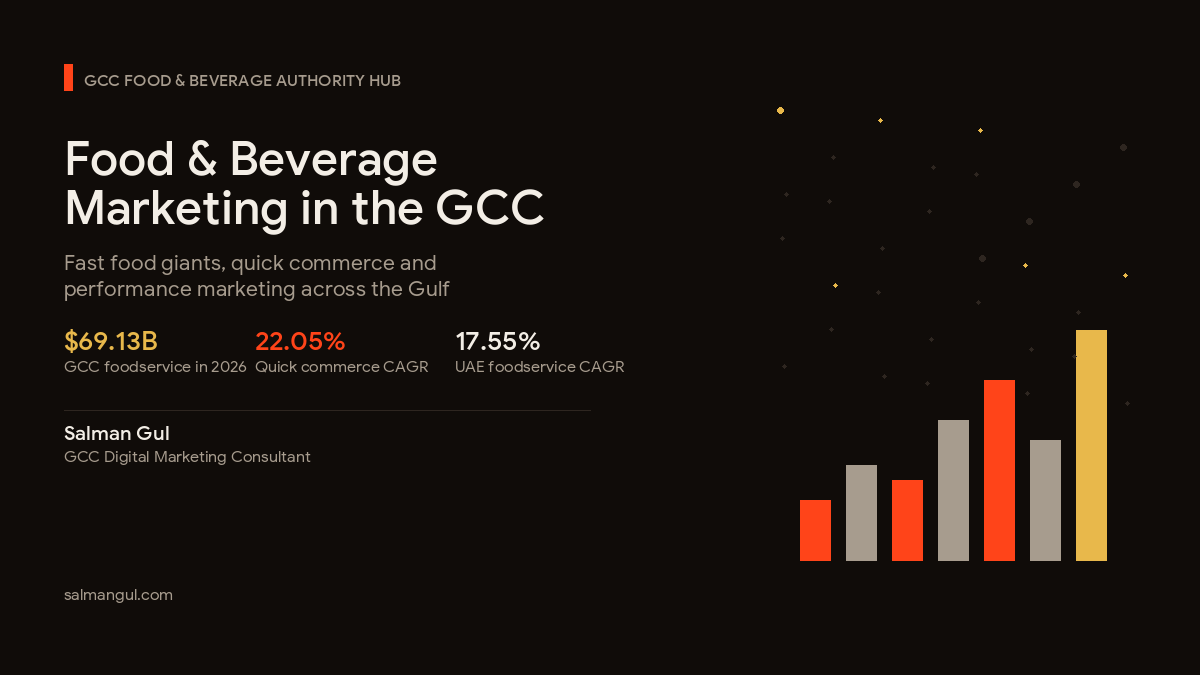
Food and Beverage Marketing in the GCC
GCC food & beverage marketing
Digital, quick commerce and performance marketing for food and beverage brands in the GCC
The market data, the fast food giants, and the digital playbook for one of the world’s fastest-growing foodservice regions, where quick commerce apps are rewriting how the UAE and Saudi Arabia eat.
$69.13BGCC foodservice market size in 2026, growing at 12.07% CAGR
$12.43BGCC quick commerce market forecast by 2031, up from $4.59B
17.55%UAE foodservice CAGR, the fastest-growing market in the Gulf
42%share of GCC foodservice held by quick service restaurants
The market
The GCC is one of the world’s fastest-growing foodservice markets.
Out-of-home dining, tourism-driven demand and rapid digital adoption are pushing GCC foodservice toward $122 billion by 2031, while a parallel quick commerce boom is reshaping how that food actually reaches people. Here is what both markets look like in 2026, and where they are heading.
Chart 1
GCC foodservice market size, 2025 to 2031 (USD billion)
Source: Mordor Intelligence, GCC Foodservice Market (2026), 12.07% CAGR 2026-2031. 2028 and 2029 are CAGR-interpolated indicative years.
Chart 2
GCC quick commerce market size, 2026 to 2031 (USD billion)
Source: Mordor Intelligence, GCC Quick Commerce Market (2026), 22.05% CAGR 2026-2031. 2027 and 2029 are CAGR-interpolated indicative years.
Three numbers frame the opportunity. The GCC foodservice market is worth about USD 69.13 billion in 2026, on its way to USD 122.19 billion by 2031 at a 12.07% CAGR. Sitting inside that market, and growing more than twice as fast at 22.05% CAGR, GCC quick commerce is set to nearly triple from USD 4.59 billion to USD 12.43 billion over the same period. Quick service restaurants already hold 42% of foodservice revenue, and delivery is the fastest-growing service type in the region, which means the apps carrying that food to the door are no longer a side channel, they are becoming the primary growth engine of GCC food and beverage.
Country by country
Where the demand actually sits
| Market | Position in 2026 | What is driving it |
|---|---|---|
| Saudi Arabia | Largest, ~47.27% of GCC foodservice sales | Population scale, Vision 2030 giga-projects, NEOM and Red Sea Project dining demand |
| UAE | Fastest-growing, 17.55% foodservice CAGR | Tourism, premium dining, dense urban delivery infrastructure, quick commerce innovation |
| Saudi Arabia (quick commerce) | 54.76% of GCC quick commerce value | Deepest dark-store footprint in the Gulf, active multi-platform competition |
| Kuwait | Fastest-rising foodservice CAGR, 13.89% | Home to Americana and Alshaya, the region’s largest restaurant franchise groups |
| Qatar, Oman, Bahrain | Smaller but expanding | Cross-border platform expansion, rising delivery and cloud kitchen penetration |
Sources: Mordor Intelligence GCC and Saudi Arabia and UAE Foodservice Market reports; Mordor Intelligence GCC Quick Commerce Market report (2026).
The category
What is reshaping GCC food and beverage
Two forces define GCC food and beverage right now: a handful of dominant franchise groups run most of the fast food the region eats, while a fast-consolidating set of quick commerce apps increasingly decide how and when that food actually arrives.
Force 01
The Franchise Powerhouses
Global fast food names in the GCC are almost entirely run by a handful of master franchise groups, and homegrown chains like ALBAIK have built cult followings that rival any international brand.
Americana alone operates KFC, Pizza Hut, Hardee’s, Krispy Kreme and Costa across the region
See the roadmap →
Force 02
Quick Commerce as the Growth Engine
Delivery has become the fastest-growing service type in GCC foodservice, and a small set of super-apps are consolidating fast through acquisitions, cross-border expansion and dark-store networks.
GCC quick commerce is growing at 22.05% CAGR, nearly double foodservice overall
See the roadmap →
Fast food landscape
The brands running GCC fast food
Most of the familiar global fast food names on GCC streets are not run by the brands themselves, they are run by a small number of powerful regional master franchise groups. Americana Restaurants International PLC, dual-listed in Abu Dhabi and Riyadh, operates KFC, Pizza Hut, Hardee’s, Krispy Kreme and Costa Coffee across the Middle East, making it one of the largest restaurant operators in the region by outlet count. M.H. Alshaya Co., the Kuwait-based franchise giant, runs Starbucks, Five Guys, Shake Shack and PF Chang’s across the Gulf, alongside a vast non-food retail portfolio. Alamar Foods, listed on the Saudi exchange, holds the Domino’s Pizza and The Cheesecake Factory franchise rights across Saudi Arabia and wider MENA, while McDonald’s Corporation and Yum! Brands, the parent of KFC, Pizza Hut and Taco Bell globally, license their operations to regional master franchisees rather than running stores directly.
Homegrown chains compete just as fiercely for the same customer. ALBAIK Food Systems, a Saudi fried-chicken chain with a devoted following that borders on cultural phenomenon, and Kudu Company, another Saudi-founded quick-service chain, both hold their own against the international giants without ever needing to leave the Kingdom. This franchise structure matters enormously for marketing: a campaign targeting KFC in Saudi Arabia is really a campaign running through Americana’s regional marketing organisation, not a conversation with corporate KFC, and understanding which group actually operates a brand in which market is the first step to marketing to, or through, GCC fast food.
Quick commerce
The apps deciding how GCC food arrives
Quick commerce has moved from convenience feature to structural growth engine for GCC food and beverage, and the numbers show why. The GCC quick commerce market is projected to grow from USD 4.59 billion in 2026 to USD 12.43 billion by 2031 at a 22.05% CAGR, nearly double the pace of foodservice overall, and Saudi Arabia alone commands 54.76% of that value on the strength of the deepest dark-store footprint in the Gulf. Talabat, now a publicly listed holding company, posted a pro forma 2024 grocery and retail GMV exceeding USD 2.5 billion after completing its acquisition of InstaShop in March 2025, while its wider platform GMV reached USD 7.4 billion in 2024. Careem, HungerStation, backed by Delivery Hero’s global logistics expertise, Noon Minutes, and Jahez International, a Tadawul-listed Saudi platform, round out the region’s dominant delivery ecosystem.
Consolidation is accelerating fast. Jahez acquired a 76.56% stake in Qatar’s Snoonu for USD 245 million in July 2025, its first move outside Saudi Arabia, and in October 2025 Jahez partnered with noon to merge quick commerce and food delivery into a single consumer app in Saudi Arabia. Amazon entered with an asset-light 15-minute delivery model in Dubai and Abu Dhabi, ADNOC turned its fuel-station network into fulfilment nodes through a partnership with noon, and Meituan’s China-backed Keeta launched an ambitious expansion across the UAE, Kuwait, Qatar, Bahrain and Oman, targeting USD 6 billion in GMV by 2028. For an F&B brand, the practical reality is that visibility inside these apps, sponsored placements, in-app promotions, dark-store proximity, now sits alongside a physical location as a genuine growth channel, not an optional add-on.
Saudi vs UAE
Two different growth stories
Saudi Arabia and the UAE are both essential GCC food and beverage markets, but they are winning in different ways. Saudi Arabia is the scale leader, commanding roughly 47.27% of GCC foodservice sales and 54.76% of quick commerce value, powered by sheer population size, Vision 2030 giga-projects like NEOM and the Red Sea Project, and the deepest dark-store network in the region. The UAE is the speed and innovation leader, growing foodservice at a 17.55% CAGR, nearly double Saudi Arabia’s 8.11%, driven by tourism, premium dining demand and a dense, tech-literate urban population that has made Dubai and Abu Dhabi the region’s proving ground for 15-minute delivery models like Amazon Now.
The library
The food and beverage marketing playbooks
This hub grows into a full library of F&B-specific marketing playbooks, each built on the same standard as the rest of this site: real data, worked context, and execution you can actually use.
Who is writing this
Over a decade inside GCC digital and performance marketing
I am Salman Gul. For over a decade I have run digital and performance marketing across the GCC, including hands-on ecommerce, retail and quick-commerce-adjacent operations across the UAE, Saudi Arabia and Bahrain, covering paid media, performance, CRM and retention, and the day-to-day of actually selling in this region, in-app, online and in-store.
10+ yrs
in GCC digital and performance marketing across retail, ecommerce and consumer categories.
4 yrs
running GCC ecommerce, sales and retail operations end to end.
Full funnel
paid media, performance, CRM, retention, merchandising and conversion.
Data-led
every decision tied to revenue, repeat rate and true category economics.
Questions
GCC food and beverage market FAQs
How big is the GCC food and beverage market?
The GCC foodservice market is valued at USD 69.13 billion in 2026 and is forecast to reach USD 122.19 billion by 2031, a 12.07% CAGR. Saudi Arabia commands roughly 47.27% of regional sales, while the UAE is the fastest-growing major market at a 17.55% CAGR. Quick service restaurants alone hold about 42% of total foodservice revenue.
Which companies run the big fast food brands in the GCC?
A small number of master franchise groups operate most global fast food chains in the region. Americana Restaurants International PLC runs KFC, Pizza Hut, Hardee’s, Krispy Kreme and Costa Coffee. M.H. Alshaya Co. operates Starbucks, Five Guys, Shake Shack and PF Chang’s. Alamar Foods holds Domino’s Pizza and The Cheesecake Factory rights across Saudi Arabia and MENA. Homegrown chains like ALBAIK and Kudu compete strongly alongside them, particularly in Saudi Arabia.
How big is quick commerce in the GCC and how fast is it growing?
The GCC quick commerce market is projected to grow from USD 4.59 billion in 2026 to USD 12.43 billion by 2031, a 22.05% CAGR, nearly double the growth rate of foodservice overall. Saudi Arabia holds about 54.76% of that value, the largest share in the region, driven by the deepest dark-store network in the Gulf and intense multi-platform competition.
What are the main quick commerce and delivery apps in the GCC?
Talabat, now publicly listed, leads with a 2024 platform GMV of USD 7.4 billion and over USD 2.5 billion in grocery and retail GMV after acquiring InstaShop. Careem, HungerStation, Noon Minutes and Jahez International are major regional platforms, alongside newer entrants like Amazon Now, Meituan’s Keeta, and Rabbit. Consolidation is accelerating, with Jahez acquiring a majority stake in Qatar’s Snoonu and partnering with noon to merge food delivery and quick commerce into one app.
Why is quick commerce becoming so important for GCC food and beverage brands?
Because delivery is the fastest-growing service type in GCC foodservice, and quick commerce apps increasingly control how and when food reaches the customer, not just where they discover it. Visibility inside these apps, through sponsored placements, in-app promotions and dark-store or delivery-radius proximity, has become as important to a food brand’s growth as its physical location, making app strategy a core marketing discipline rather than an operational afterthought.
How does the GCC food and beverage opportunity differ between Saudi Arabia and the UAE?
Saudi Arabia is the scale leader, with about 47.27% of GCC foodservice sales and 54.76% of quick commerce value, powered by population size and Vision 2030 giga-projects like NEOM. The UAE is the speed and innovation leader, growing foodservice at 17.55% CAGR against Saudi Arabia’s 8.11%, driven by tourism, premium dining and a dense urban population that has made Dubai and Abu Dhabi the region’s testing ground for 15-minute delivery models.
Get in touch
Building or scaling a food and beverage brand in the GCC?
I bring over a decade of GCC digital and performance marketing experience, including hands-on ecommerce and retail operations across the UAE, Saudi Arabia and Bahrain, to quick commerce strategy, franchise and QSR marketing, and the performance and loyalty systems that turn Gulf appetite into repeat orders.
Email salmangul@hotmail.com