
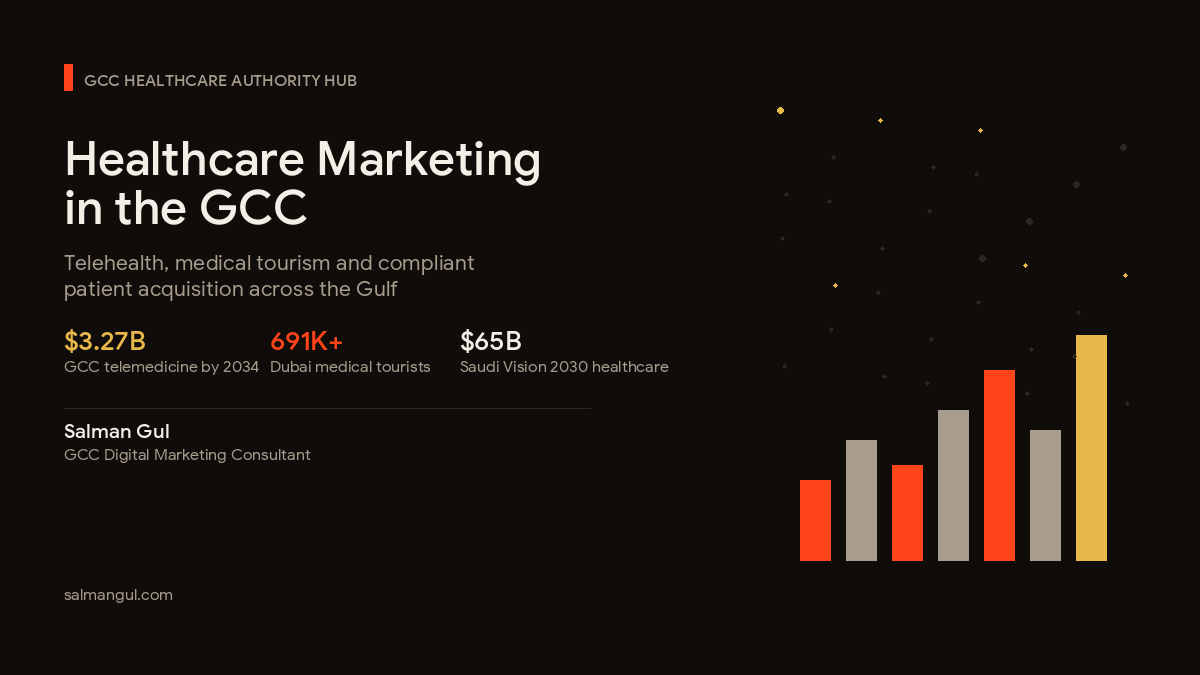
Healthcare Marketing in the GCC
GCC healthcare marketing
Digital and performance marketing for healthcare providers in the GCC
The market data, the regulatory reality, and the digital playbook for one of the world’s fastest-growing healthcare regions, where telehealth, medical tourism and Vision 2030 investment are reshaping how patients find and choose care across Saudi Arabia and the UAE.
$3.27BGCC telemedicine market forecast by 2034, growing at 21.67% CAGR
$4Bcombined Saudi and UAE digital health market by 2026
691,000+international health tourists welcomed by Dubai alone, generating AED 1.03B
$65BSaudi Vision 2030 investment in healthcare infrastructure
The market
The GCC is running one of the world’s fastest healthcare transformations.
Vision 2030 investment, an ageing and chronic-disease-affected population, and world-class medical tourism infrastructure are converging on the same digital shift: patients increasingly discover, book and review care online, and the providers investing in that digital experience are pulling ahead. Here is what that market looks like in 2026.
Chart 1
GCC telemedicine market size, 2026 to 2034 (USD million)
Source: IMARC Group, GCC Telemedicine Market (2026-2034), 21.67% CAGR. 2026, 2029 and 2032 are CAGR-interpolated indicative years.
Chart 2
GCC medical tourism market size, 2025 to 2032 (USD million)
Source: Credence Research, GCC Medical Tourism Market (2025-2032), 10.26% CAGR. 2025 and 2028 are CAGR-interpolated indicative years.
Three numbers frame the opportunity. The GCC telemedicine market is on track to reach USD 3.27 billion by 2034 at a 21.67% CAGR, while Saudi Arabia and the UAE’s combined digital health market alone is projected to hit USD 4 billion by 2026. Sitting alongside that digital shift, medical tourism is a genuine economic pillar in its own right, Dubai alone welcomed 691,000-plus international health tourists generating over AED 1.03 billion in revenue, and Cleveland Clinic Abu Dhabi saw a 35% surge in international patient volume in a single year. For a healthcare provider, this means the digital patient journey, discovery, booking, review, and increasingly international patient acquisition, is no longer a secondary channel, it sits alongside clinical reputation as a primary driver of growth.
Country by country
Where the investment and the patients are
| Market | Position in 2026 | What is driving it |
|---|---|---|
| Saudi Arabia | Largest infrastructure investment, $65B under Vision 2030 | 30,000+ new hospital beds, SFDA regulation, NUPCO centralised procurement, Seha/Mawid/Tabaud apps |
| UAE | Medical tourism leader, 691,000+ visitors to Dubai alone | DHA, DOH and MOHAP regulation, JCI-certified facilities, NABIDH health information exchange |
| Qatar | Fastest-growing MedTech testbed, $15.2B to $16.6B by 2032 | Advanced healthcare technology piloting ahead of wider GCC rollout |
| Kuwait, Bahrain, Oman | Smaller but expanding steadily | NHRA regulation in Bahrain, rising organised private healthcare investment |
Sources: IMARC Group GCC Telemedicine Market report; Credence Research GCC Medical Tourism Market report; The Global Economics Qatar healthcare analysis (2026).
The category
What is reshaping GCC healthcare
Two forces are converging on the same patient journey: government-backed telehealth infrastructure is making digital-first care the default, while a genuinely world-class medical tourism sector is turning international patient acquisition into a serious marketing discipline in its own right.
Force 01
Telehealth and Digital-First Care
Government apps, virtual clinics and unified health records have made booking, consulting and reviewing care digitally the default expectation, not an add-on service.
GCC telemedicine growing at 21.67% CAGR through 2034
See the roadmap →
Force 02
Medical Tourism as an Economic Pillar
Governments and hospital groups are actively marketing the GCC internationally, and JCI-certified facilities are competing for patients well beyond the region’s own population.
Dubai alone welcomed 691,000+ international health tourists
See the roadmap →
Regulation
The regulatory reality
Healthcare marketing in the GCC operates inside a genuinely strict regulatory framework, and understanding it is the first requirement before running a single campaign. Saudi Arabia’s SFDA governs medical device and healthcare product marketing and registration, the UAE splits regulatory authority across the Ministry of Health and Prevention, the Dubai Health Authority and the Department of Health Abu Dhabi, each with its own advertising and licensing rules, and Bahrain’s NHRA adds a further distinct framework. These bodies govern what a clinic or hospital can claim in an advertisement, how patient data can be handled, and which health information can be published publicly at all.
For a marketer, this means healthcare campaigns cannot be planned the way a retail or F&B campaign is planned, every claim needs to be substantiated, every patient testimonial needs proper consent, and every performance-marketing platform needs to be configured to respect health-data sensitivity, since Meta and Google both apply special ad category rules to healthcare content. Providers who treat compliance as a constraint to work around rather than a framework to build inside consistently run into rejected ads, regulatory penalties or reputational damage, while those who build compliant creative and targeting from the outset are the ones actually able to scale their digital patient acquisition sustainably.
Telehealth
The digital-first shift
Government-backed telehealth infrastructure has moved from pilot project to core delivery mechanism across the region. Saudi Arabia’s Ministry of Health runs Mawid, Tabaud and Seha, apps offering everything from appointment booking to full virtual consultations, and the Kingdom launched the region’s largest health information exchange in 2022, consolidating data from more than 5,000 healthcare organisations. In the UAE, initiatives like Doctor for Every Citizen and SEHA Virtual Clinics demonstrate the same foundational shift, and Dubai’s NABIDH health information exchange now holds 9.5 million patient records and connects more than 1,500 healthcare facilities, enabling a genuinely unified digital patient record across a fragmented private and public system.
Global platforms are building GCC-specific operations to serve this shift, Teladoc Health, one of the world’s largest virtual care companies, now holds comprehensive GCC enterprise contracts, and competitive differentiation in the region increasingly depends on Saudi and UAE data centre presence, MOH regulatory certification, and genuine Arabic clinical AI capability, exactly the sovereign infrastructure themes covered in this site’s AI and automation cluster. For a healthcare provider, telehealth is no longer a convenience feature, it is intrinsic to how patients now expect to access care, and a digital marketing strategy that does not account for this shift is marketing to a patient behaviour that no longer exists.
Medical tourism
A serious digital marketing vertical
Medical tourism in the GCC has evolved from a side benefit of good healthcare into a deliberately marketed economic pillar. Dubai alone welcomed over 691,000 international health tourists, generating more than AED 1.03 billion in revenue, and Cleveland Clinic Abu Dhabi handled over one million patient encounters with a 35% surge in international visitors seeking complex treatment in a single year. The patient demographics are genuinely global, women represent 58% of international patients, with the largest source markets being Asia at 33%, other GCC Arab nations at 28%, and Europe and the CIS at 23%, spanning specialties from fertility and cardiac care to oncology, orthopaedics and cosmetic surgery.
The infrastructure behind this is deliberately built for international discovery, Dubai’s government-run Dubai Health Experience platform lets medical tourists compare verified providers and book treatment online, and major operators are investing accordingly, Burjeel Holdings reported 10.5% revenue growth in 2024 to AED 5 billion while treating over 6.5 million patients, and American Hospital Dubai has opened international medical tourism offices as far afield as Lagos, Nigeria, with plans for up to 30 centres across Africa and Eastern Europe. For a hospital group or specialty clinic, this means international patient acquisition, multilingual content, destination marketing, streamlined booking, deserves its own dedicated marketing strategy, not a footnote inside a domestic patient-acquisition plan.
The library
The healthcare marketing playbooks
This hub grows into a full library of healthcare-specific marketing playbooks, each built on the same standard as the rest of this site: real data, worked context, and execution you can actually use.
Who is writing this
Over a decade inside GCC digital and performance marketing
I am Salman Gul. For over a decade I have run digital and performance marketing across the GCC, working inside regulated advertising environments across multiple categories, covering paid media, performance, CRM and retention, and the compliance-aware execution a regulated GCC industry like healthcare genuinely demands.
10+ yrs
in GCC digital and performance marketing across regulated and consumer categories.
4 yrs
running GCC ecommerce, sales and retail operations end to end.
Full funnel
paid media, performance, CRM, retention and conversion, built compliance-first.
Data-led
every decision tied to patient acquisition cost, retention and true category economics.
Questions
GCC healthcare market FAQs
How big is the GCC healthcare and digital health market?
The GCC telemedicine market is projected to reach USD 3.27 billion by 2034, growing at a 21.67% CAGR, while Saudi Arabia and the UAE’s combined digital health market alone is forecast to hit USD 4 billion by 2026. Saudi Arabia is investing USD 65 billion in healthcare infrastructure under Vision 2030, including over 30,000 new hospital beds, making the Kingdom the region’s largest single healthcare investment programme.
Which regulators govern healthcare marketing in the GCC?
Saudi Arabia’s SFDA governs medical device and healthcare product marketing and registration, the UAE splits authority across the Ministry of Health and Prevention, the Dubai Health Authority and the Department of Health Abu Dhabi, and Bahrain’s NHRA adds a further distinct framework. Each governs advertising claims, patient testimonial consent and health data handling, and Meta and Google both apply special ad category rules to healthcare content on top of these local regulations.
How significant is medical tourism in the GCC?
Very significant and growing. Dubai alone welcomed over 691,000 international health tourists generating more than AED 1.03 billion in revenue, and Cleveland Clinic Abu Dhabi saw a 35% surge in international patient volume in a single year, treating over a million patient encounters overall. Women represent 58% of international patients, with the largest source markets being Asia, other GCC Arab nations, and Europe and the CIS.
What telehealth infrastructure exists across the GCC?
Saudi Arabia’s Ministry of Health runs Mawid, Tabaud and Seha for booking and virtual consultations, backed by the region’s largest health information exchange, launched in 2022 and consolidating data from over 5,000 healthcare organisations. The UAE runs Doctor for Every Citizen and SEHA Virtual Clinics, and Dubai’s NABIDH exchange holds 9.5 million patient records connecting more than 1,500 facilities, making digital-first care the regional default rather than an add-on.
Who are the major healthcare operators in the GCC?
Burjeel Holdings reported 10.5% revenue growth in 2024 to AED 5 billion while treating over 6.5 million patients. Aster DM Healthcare operates 15 hospitals, 117 clinics and 285 pharmacies across the GCC. Cleveland Clinic Abu Dhabi and M42 Group, Abu Dhabi’s AI-powered health leader with a 480-clinic network, anchor the UAE’s international patient strategy, alongside NMC Health and Mediclinic in the wider private hospital landscape.
How does healthcare marketing differ from other GCC industries?
It operates inside a genuinely strict regulatory framework where every advertising claim needs substantiation, every patient testimonial needs proper consent, and paid platforms like Meta and Google apply special ad category restrictions to health content. Providers who build compliant creative and targeting from the outset are able to scale digital patient acquisition sustainably, while those treating compliance as an afterthought face rejected ads, regulatory penalties or reputational damage.
Get in touch
Building patient acquisition for a GCC healthcare brand?
I bring over a decade of GCC digital and performance marketing experience, including work inside regulated advertising environments, to compliant patient acquisition, medical tourism marketing, and the local SEO and reputation systems that turn a GCC healthcare provider’s clinical excellence into genuine digital visibility.
Email salmangul@hotmail.com