
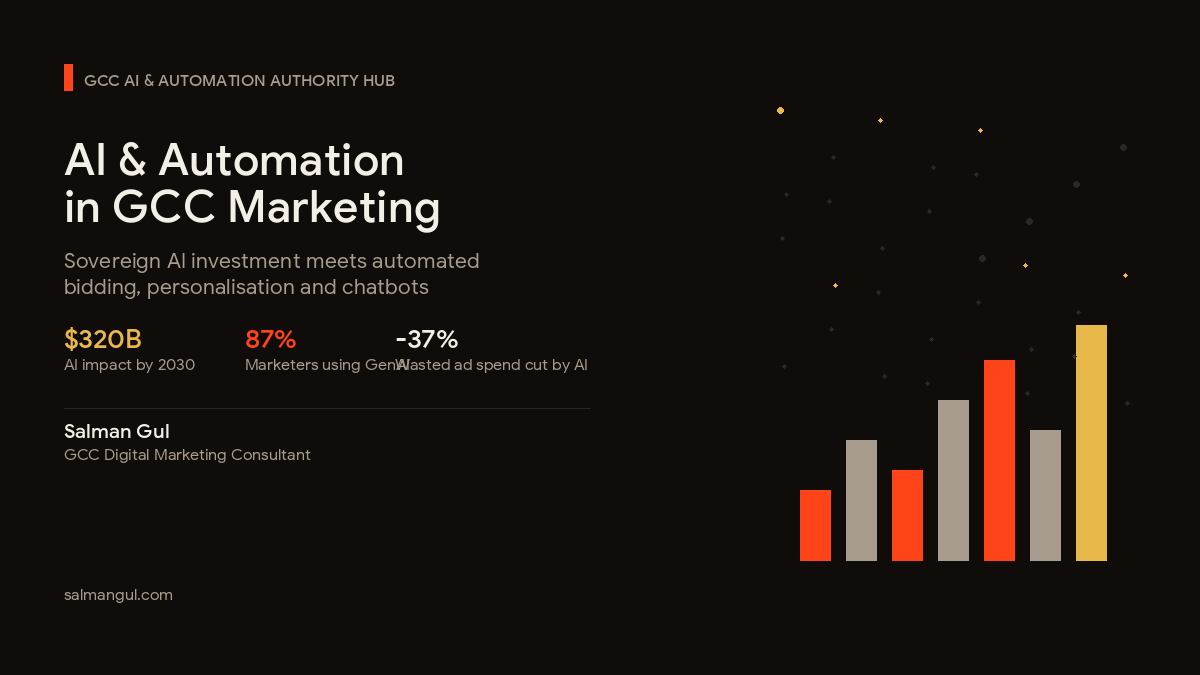
AI and Automation in GCC Marketing
GCC AI & automation
AI and automation in GCC marketing: sovereign investment meets the customer moment
The Gulf is spending tens of billions of dollars to become a global AI hub, and that same infrastructure is already reshaping how brands bid, personalise, chat and create across Saudi Arabia, the UAE and the wider GCC. Here is what that means for a marketer, not just an economy.
$320BAI’s projected contribution to the Middle East economy by 2030
$30B+already invested by GCC governments in AI infrastructure by early 2025
74%of GCC organisations already using generative AI in at least one function
-37%wasted ad spend from AI-powered bid management
The market
The GCC is running one of the world’s largest sovereign AI bets.
Saudi Arabia and the UAE are not simply adopting AI, they are building the compute, capital and national strategy to become a global AI hub, and that infrastructure is already flowing directly into how brands market and sell. Here is the scale of the bet, and the marketing-specific layer sitting on top of it.
Chart 1
From investment to impact: AI and the Middle East economy (USD billion)
Sources: Precedence Research (GCC AI investment, early 2025); PwC (AI’s projected contribution to the Middle East economy by 2030). Figures measure different things, committed capital versus projected economic contribution, shown together to illustrate the scale of the multiplier being targeted.
Chart 2
GCC AI copilot market size, 2026 to 2031 (USD billion)
Source: Mordor Intelligence, GCC AI Copilot Market (2026-2031, 32.72% CAGR). 2028 and 2030 are CAGR-interpolated indicative years.
Three numbers frame the opportunity. GCC governments had already committed more than USD 30 billion to AI infrastructure by early 2025, and PwC projects AI will contribute up to USD 320 billion to the Middle East economy by 2030. Sitting on top of that infrastructure, the GCC AI copilot market alone is forecast to grow from USD 0.88 billion in 2026 to USD 3.61 billion by 2031, a 32.72% CAGR, and globally 87% of marketers now use generative AI in at least one workflow, up from just 51% two years earlier. The sovereign AI race and the marketing AI adoption curve are not two separate stories, they are the same infrastructure build showing up first as national strategy, then as the tools a brand actually uses to bid, personalise and create.
Country by country
Where the AI bet is being placed
| Market | Position in 2026 | What is driving it |
|---|---|---|
| Saudi Arabia | Largest absolute AI economic impact, ~$135.2B by 2030 | HUMAIN, SDAIA, $14.9B LEAP 2025 pledge, Vision 2030 tying 66 of 96 goals to AI and data |
| UAE | Highest relative GDP impact, 14% by 2030 | G42, $25B MGX fund, Stargate UAE, world’s first AI Minister since 2017 |
| Qatar | Fastest-growing AI copilot CAGR, 34.72% | $20B Brookfield-Qai sovereign infrastructure partnership (Dec 2025) |
| Kuwait, Oman, Bahrain | Steadier, template-following adoption | Regional vendor expansion, growing enterprise familiarity with copilots |
Sources: Precedence Research GCC AI economic growth analysis; Mordor Intelligence GCC AI Copilot Market report (2026); Crowell & Moring Middle East AI and Data Security briefing.
The category
What is reshaping GCC marketing
Two forces sit on top of each other in the GCC right now: national governments are building sovereign AI infrastructure at a scale few regions can match, and that same infrastructure is already reaching down into the everyday tools a GCC marketer uses to bid, personalise and create.
Force 01
Sovereign AI Infrastructure
HUMAIN, G42 and multi-billion-dollar national funds are building the compute and capital that positions the Gulf as a genuine third force in global AI, after the US and China.
$30B+ already committed by GCC governments by early 2025
See the roadmap →
Force 02
AI-Powered Marketing and Automation
Automated bidding, generative creative, WhatsApp AI chatbots and predictive personalisation are moving from pilot to default across GCC brands, with adoption now effectively universal among marketers.
87% of marketers use generative AI in at least one workflow
See the roadmap →
National strategy
The national AI race
Saudi Arabia is leveraging its cost-effective energy infrastructure to become, in its own stated ambition, the world’s third force in AI after the United States and China. HUMAIN, the Kingdom’s AI-powered operating systems firm backed by the Public Investment Fund, has struck a USD 10 billion partnership with Google Cloud to build a global AI hub, a USD 5 billion AI Zone with AWS, and a USD 3 billion deal with Blackstone to build up to six gigawatts of data centre capacity nationwide by 2034. Saudi Arabia unveiled more than USD 14.9 billion in AI and digital infrastructure investment at LEAP 2025 alone, part of a broader USD 100 billion Project Transcendence initiative, and SDAIA, the Saudi Data and AI Authority, has invested over USD 5 billion in national AI infrastructure directly, with 66 of Saudi Arabia’s 96 Vision 2030 strategic goals tied explicitly to data and AI capabilities.
The UAE is running its own parallel bet through G42, its indigenous AI vehicle, now operational in partnership with OpenAI, Oracle, Nvidia and Cisco on Stargate UAE, a data centre project reported at up to USD 500 billion, positioned to be the largest of its kind outside the United States. The UAE has allocated USD 25 billion through its MGX fund for AI data centres and semiconductor manufacturing, and became the first country in the world to appoint a dedicated AI Minister, back in 2017, well ahead of the current global AI investment wave. Qatar has entered the race more recently but decisively, with a USD 20 billion Brookfield-Qai sovereign infrastructure partnership announced in December 2025, positioning it as the fastest-growing AI copilot market in the GCC through 2031.
Marketing applications
AI in GCC marketing and advertising
The practical AI marketing layer sitting on top of this infrastructure is growing 30% or more annually across MENA, and AI-powered paid advertising is already the highest-adoption use case in the region, with AI managing campaigns across Google, Meta, TikTok, Snapchat and X through automated bid management, dynamic creative optimisation and real-time budget allocation. The performance case is measurable rather than theoretical: AI-powered bid management has been shown to reduce wasted ad spend by 37% and increase ad ROI by 50%, and AI-run campaigns broadly generate 22% higher returns, 32% higher conversion rates and 29% lower cost per acquisition than conventionally managed campaigns. AI-driven personalisation is now responsible for nearly 45% of all online conversions.
Conversational AI has found a genuinely distinctive home in the GCC specifically, built on the region’s uniquely dominant WhatsApp usage, with 96% of UAE smartphone users and 94% of Saudi smartphone users actively on WhatsApp. WhatsApp AI chatbots hold 38% share of the GCC AI chatbot and conversational AI market, the highest WhatsApp chatbot penetration of any market globally, and the segment is growing at 41.2% CAGR, the fastest of any AI category tracked in the region, with Saudi Arabia growing fastest of all at 48.1% year on year, driven partly by a government mandate requiring all Saudi government agencies to offer AI-powered citizen services by 2027.
The human layer
The human-AI balance
Adoption is not the same as advantage, and the region’s own marketing commentary is explicit about where the real edge sits: the winners will be brands that pair AI’s data horsepower with human creativity and cultural insight, not automation alone, especially in bilingual markets where Arabic nuance genuinely matters. This caution is borne out in the platform data itself, Meta, TikTok and Google have all quietly begun down-ranking obviously AI-generated paid social creative in their 2026 ranking updates, and the widely cited 30% rule, keeping at least 30% of AI-assisted content human-led through editing, strategic oversight and cultural judgement, exists specifically to protect quality and avoid the consumer distrust that comes with fully automated output.
The next frontier is agentic AI, systems that can plan, execute and iterate on multi-step marketing campaigns with minimal human input, with 50% of enterprises already using generative AI expected to deploy autonomous AI agents by 2027, up from 25% in 2025. For a GCC brand, the practical read is that AI adoption itself is no longer the differentiator, given how close to universal it already is, the differentiator is disciplined, culturally fluent human oversight layered on top of it.
The library
The AI and automation marketing playbooks
This hub grows into a full library of AI and automation playbooks for GCC marketers, each built on the same standard as the rest of this site: real data, worked context, and execution you can actually use.
Who is writing this
Over a decade inside GCC digital and performance marketing
I am Salman Gul. For over a decade I have run digital and performance marketing across the GCC, and every one of those years has meant working with the automated bidding, personalisation and AI tooling that now sits inside every major ad platform, applied to real budgets and real revenue targets, not theory.
10+ yrs
in GCC digital and performance marketing, working directly with AI-powered ad platforms.
4 yrs
running GCC ecommerce, sales and retail operations end to end.
Full funnel
paid media, performance, CRM, retention, merchandising and conversion.
Culturally fluent
Arabic and English execution, where AI output still needs a human, cultural edit.
Questions
GCC AI and automation FAQs
How much is the GCC investing in AI?
GCC governments had committed more than USD 30 billion to AI infrastructure by early 2025, led by Saudi Arabia and the UAE. Saudi Arabia alone unveiled over USD 14.9 billion in AI investment at LEAP 2025, part of a broader USD 100 billion Project Transcendence initiative, while the UAE has allocated USD 25 billion through its MGX fund for AI data centres and semiconductor manufacturing. PwC projects AI will contribute up to USD 320 billion to the Middle East economy by 2030.
What are HUMAIN and G42?
HUMAIN is Saudi Arabia’s Public Investment Fund-backed AI operating systems company, which has struck major partnerships including a USD 10 billion deal with Google Cloud and a USD 5 billion AI Zone with AWS. G42 is the UAE’s indigenous AI vehicle, operating dozens of data centres and partnering with OpenAI, Oracle, Nvidia and Cisco on Stargate UAE, a data centre project reported at up to USD 500 billion. Both function as their country’s national AI champion.
How widely is AI actually used in GCC marketing?
Adoption is close to universal. Globally, 87% of marketers use generative AI in at least one workflow, up from 51% just two years earlier, and 74% of GCC organisations are already using generative AI in at least one business function. AI-powered paid advertising is the highest-adoption use case specifically, with AI managing bidding, creative optimisation and budget allocation across Google, Meta, TikTok, Snapchat and X.
Why are WhatsApp AI chatbots so dominant in the GCC?
Because WhatsApp usage in the region is exceptionally high, with 96% of UAE smartphone users and 94% of Saudi smartphone users actively on the platform. WhatsApp AI chatbots hold 38% share of the GCC AI chatbot market, the highest WhatsApp chatbot penetration of any market globally, and the category is growing at 41.2% CAGR, partly driven by a Saudi government mandate requiring AI-powered citizen services by 2027.
Does AI-generated content actually perform better?
It depends heavily on how it is used. AI-powered bid management reduces wasted ad spend by 37% and increases ad ROI by 50%, and AI-driven personalisation now drives nearly 45% of online conversions. However, Meta, TikTok and Google have begun down-ranking obviously AI-generated paid social creative in 2026, which is why the widely cited 30% rule, keeping at least 30% of AI-assisted content human-edited, matters for quality and platform performance alike.
What is agentic AI and why does it matter for GCC brands?
Agentic AI refers to systems that can plan, execute and iterate on multi-step marketing campaigns with minimal human input, moving beyond simple content generation into autonomous execution. 50% of enterprises already using generative AI are expected to deploy AI agents by 2027, up from 25% in 2025, making this the next major shift GCC brands will need to plan for after today’s more established personalisation and bidding automation.
Get in touch
Building an AI-powered marketing function in the GCC?
I bring over a decade of GCC digital and performance marketing experience, working hands-on with the AI-powered bidding, personalisation and automation tools now built into every major platform, to help brands use AI as a genuine performance edge rather than a buzzword, without losing the cultural and Arabic-language fluency that still needs a human hand.
Email salmangul@hotmail.com