Hotel SEO in the UAE: Ranking in English and Arabic (2026)
Dubai reached 19.59 million international overnight visitors in 2025, up 5% year on year, and welcomed 2 million more in January 2026 alone. Every one of those travellers began somewhere, and increasingly that somewhere is a search box or an AI assistant. Yet most Dubai hotel websites are built to rank in only one language, for only one kind of search, in a market that is neither.
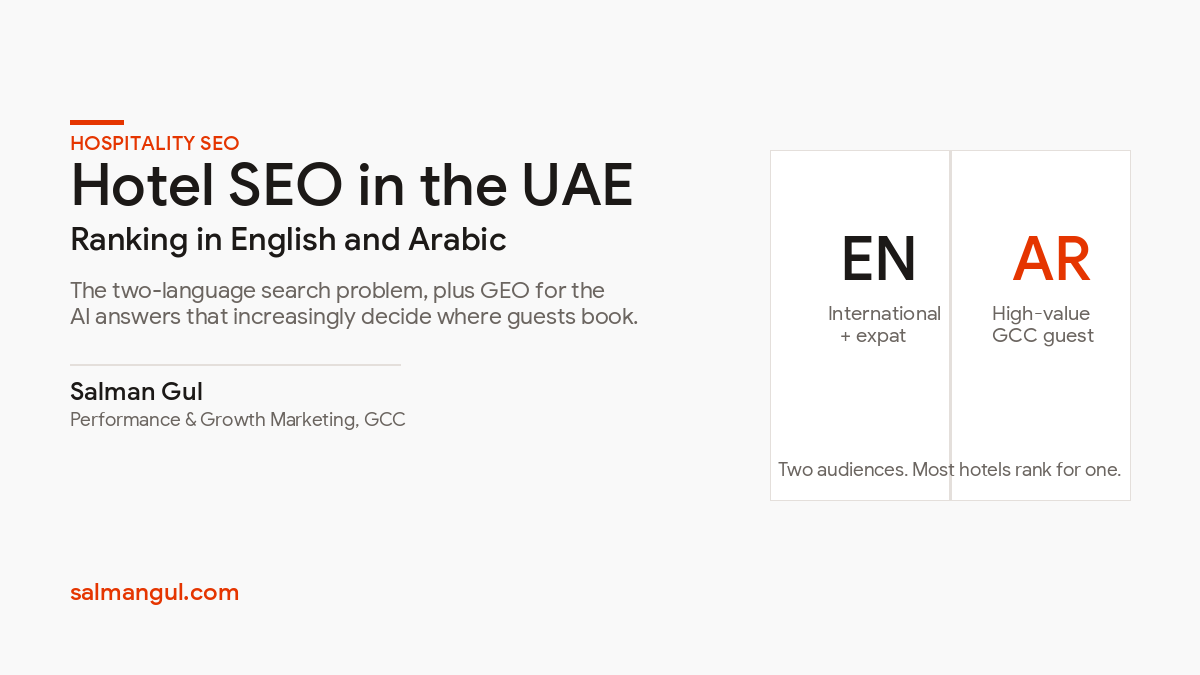
Hotel SEO in the UAE is a two-front problem: English captures international and expat demand, Arabic captures the high-spending GCC guest that English-only properties miss entirely. And underneath both, the rules of search themselves are shifting from ten blue links to AI-generated answers. This is how to win all three.
19.59MDubai international overnight visitors in 2025, up 5%
340%organic direct-booking traffic growth reported from a full hotel SEO rebuild
15-25%estimated fall in organic website traffic as AI answers rise
3-6 motypical time for hotel SEO to show meaningful results
This is one of the spoke guides behind Digital Marketing for Hotels in the GCC. It pairs directly with the OTA commission playbook, because organic search is the cheapest direct channel there is.
1. Why Hotel SEO Is a Two-Language Problem
Organic search is the lowest-cost booking channel in hospitality, roughly 2% to 5% of booking value against 25% to 42% true cost on OTAs. That alone makes it worth doing well. But in the UAE, doing it well means doing it twice.
English search captures the international inbound traveller and the large resident expat population. That is the traffic most hotel sites are built for. But it leaves the single most valuable resilient segment almost untouched: the GCC national and Arabic-speaking regional guest, who books high-value stays, travels on short notice, and is far less price-sensitive than the international leisure tourist.
English-only hotel SEO is not half a strategy. It is a strategy that concedes the highest-spending, most loyal, most shock-resistant guest segment to whichever competitor bothered to publish in Arabic.
2. The Arabic SEO Gap Nobody Is Filling
Here is the opportunity in one sentence: most UAE hotel websites either have no Arabic version, or a machine-translated one that ranks for nothing.
A flipped English page with auto-translated text is not Arabic SEO. Genuine Arabic search optimisation means Arabic-language keyword research (the terms GCC guests actually type differ from direct translations of English keywords), Arabic content written natively rather than translated, correct right-to-left page structure, and proper hreflang tags so Google serves the right language version to the right searcher.
| Element | Most UAE hotels do | What actually ranks |
|---|---|---|
| Arabic content | Machine-translated toggle | Natively written Arabic pages |
| Keyword research | Translated English terms | Genuine Arabic search terms |
| Page structure | Flipped stylesheet | Proper RTL layout and markup |
| Language targeting | None or broken | Correct hreflang implementation |
| District pages | English only | Arabic pages for Marina, Downtown, JBR, etc. |
Because so few properties do this properly, the competition for Arabic hotel search terms is a fraction of the competition for their English equivalents. It is the rare situation where the more valuable audience is also the cheaper one to rank for.
3. The Keyword Map That Drives Direct Bookings
Not all rankings are worth the same. The keyword map should be built around direct-booking revenue potential, not traffic volume. Three tiers matter.
| Tier | Search type | Examples | Intent |
|---|---|---|---|
| 1. Transactional | Ready to book | “5 star hotel Dubai Marina”, “[hotel name] official site”, “book direct best rate” | Highest. Protect and win these first. |
| 2. Experience & amenity | Comparing on features | “Dubai hotel with private beach”, “family resort JBR”, “hotel near DWTC” | High. Incremental revenue from dining, spa, MICE. |
| 3. Informational | Planning the trip | “best area to stay in Dubai”, “things to do near Downtown” | Early funnel. Capture, then nurture. |
Brand-term defence sits underneath all of this: if you are not ranking first for your own hotel name, an OTA is, and you are paying commission on a guest who was looking for you directly. Own your brand terms in both languages before anything else.
4. Technical SEO for Hotels
A beautiful hotel website still loses bookings if the technical foundation is broken. The priorities specific to hotels:
Schema markup. LodgingBusiness and Hotel structured data help Google understand your property, rooms, amenities and reviews. Most Dubai hotel sites are missing it entirely, which means Google is guessing at what they offer.
Crawlability of room pages. If Google cannot crawl individual room-type pages, those pages cannot rank. Booking-engine setups frequently hide room inventory behind JavaScript that search engines never see.
Mobile-first and speed. GCC travel research is overwhelmingly mobile. A slow booking widget loses conversions before the guest reaches checkout, and Google’s mobile-first indexing means the mobile experience is the ranking experience.
Clean multilingual URLs. Messy language URLs and missing hreflang are among the most common technical faults on multilingual hotel sites, and they directly suppress Arabic rankings.
5. Local SEO, Google Maps & Free Booking Links
When a traveller searches “hotel near me” or “luxury hotel Dubai Marina,” the Google Maps pack appears above organic results. Winning it is often more valuable than a first-page organic ranking.
The essentials: a fully optimised Google Business Profile with accurate categories, high-quality photos, active review management and correct amenities; citations across UAE hospitality directories including Visit Dubai and TripAdvisor; and, critically, Google Hotels free booking links. Free booking links send guests straight to your booking engine with no per-click fee, a direct channel most properties have simply never activated.
6. GEO: Ranking Inside AI Answers
The biggest shift in search since the smartphone is happening now, and hotels are exposed to it early because travel planning is exactly the kind of task travellers hand to AI.
The old sequence, search, click, compare, book, has loosened. A traveller today may meet your hotel inside an AI-generated answer, register its review score, and form an opinion before your website ever loads. Research cited across the industry suggests a large majority of consumers now rely on AI-generated summaries for a meaningful share of their searches, with organic website traffic down an estimated 15% to 25% in many sectors as a result.
Generative Engine Optimisation (GEO) is how you stay visible in that world. It rewards the same foundations as good SEO, plus a few specifics: clear, fact-based, well-structured content that answers real traveller questions directly; strong, recent, well-managed reviews, because AI systems weight review signals heavily when deciding which property to recommend; and accurate structured data that lets AI extract your facts correctly. Dense marketing copy is hard for AI to parse. Clear answers are not.
Frequently Asked Questions
How long does hotel SEO take to work in the UAE?
Organic SEO improvements typically show noticeable results within 3 to 6 months, with technical and on-page fixes moving fastest and content authority compounding over 6 to 18 months. It is a channel that builds durable, low-cost direct bookings rather than delivering the instant spike of paid media.
Why does a Dubai hotel need Arabic SEO?
Arabic search captures the high-spending GCC national and regional guest, a segment that is more loyal, less price-sensitive and more resilient to demand shocks than the international leisure traveller. Because most UAE hotels use only machine-translated Arabic or none at all, competition for Arabic hotel terms is far lower, so the more valuable audience is also the cheaper one to rank for.
Is machine-translated Arabic good enough for SEO?
No. A flipped, auto-translated English page rarely ranks. Genuine Arabic SEO requires native Arabic keyword research, content written in Arabic rather than translated, correct right-to-left page structure, and proper hreflang tags. The terms GCC guests actually search differ from direct translations of English keywords.
What is GEO and does it matter for hotels?
Generative Engine Optimisation is the practice of staying visible inside AI-generated answers rather than only in traditional search results. It matters acutely for hotels because travellers increasingly plan trips through AI assistants. GEO rewards clear, fact-based, well-structured content, strong recent reviews, and accurate structured data that AI systems can extract confidently.
What is the single highest-return hotel SEO action?
Brand-term defence in both languages, ranking first for your own hotel name so an OTA is not capturing guests who were already looking for you, followed by activating Google Hotels free booking links. Both convert existing demand into commission-free direct bookings, which is the cheapest revenue in hospitality.
How does SEO help reduce OTA commission?
Organic search is the lowest-cost booking channel, roughly 2% to 5% of booking value versus 25% to 42% true cost on OTAs. Every booking that arrives through organic search or free booking links instead of an OTA retains 20 or more points of revenue, which is why SEO is a core lever in any direct-booking strategy.
The Bottom Line
Hotel SEO in the UAE is won on three fronts at once: English for international and expat demand, Arabic for the high-value GCC guest almost nobody optimises for, and GEO for the AI answers that increasingly decide where travellers book. The property that covers all three captures the cheapest, most durable direct-booking channel in hospitality, while its competitors keep paying OTA commission for the same guests.
Work With Me
If you run a hotel or resort in Dubai or the wider UAE and your organic search is English-only, technically weak, or invisible to AI answers, this is exactly the work I do: bilingual hotel SEO, technical audits, Google Maps and free booking link activation, and GEO readiness.
Email me: salmangul@hotmail.com
Send me your property and your current direct-booking share, and I will show you where the organic opportunity is.