
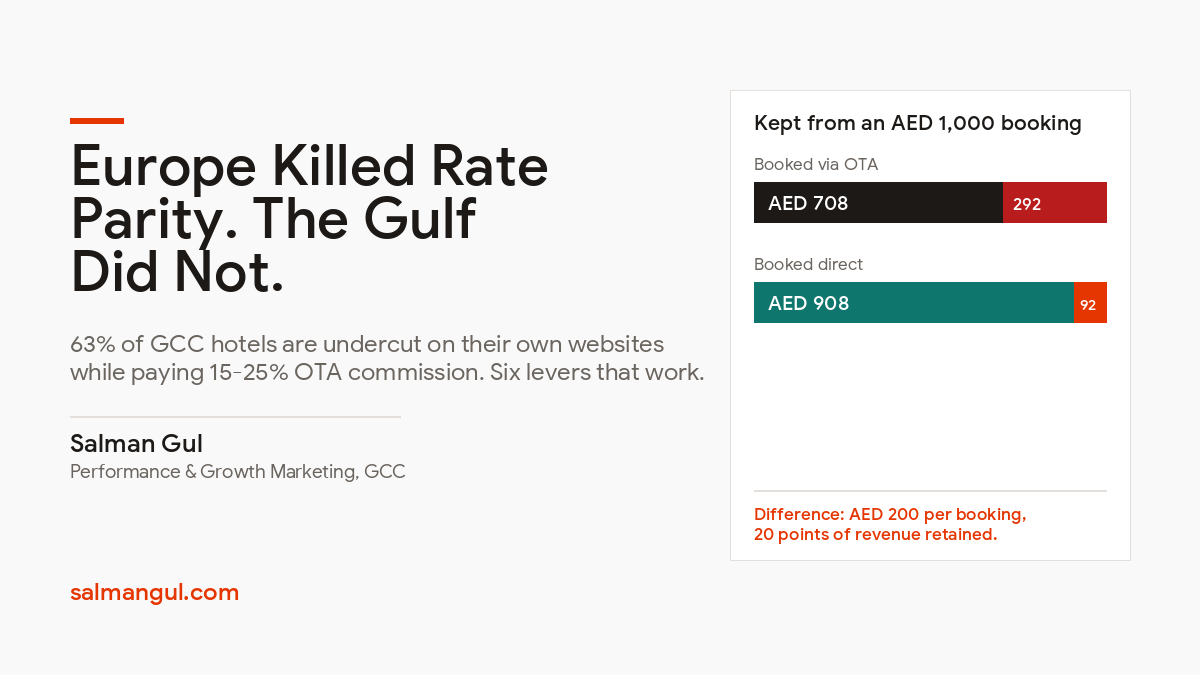
How to Reduce OTA Commission: The 2026 Direct Booking Playbook for GCC Hotels
Here is the number that should end the debate in your next commercial meeting: roughly 63% of hotel properties across the Gulf are currently displaying a higher rate on their own website than a traveller can find on an OTA.
Not the same rate. Higher.
Read that again, because it inverts the entire logic of the contract you signed. You agreed to rate parity so that guests would never find a cheaper room elsewhere. In practice you are paying 15% to 25% commission for the privilege of being undercut on your own inventory, by the platform you are paying.
Meanwhile, hotels in Europe spent the last eighteen months being handed something Gulf operators did not get: a legal exit. Rate parity clauses were dismantled across the European Economic Area. Booking.com formally waived them. The EU’s top court ruled against them. A German court ordered compensation for more than a thousand hotels.
None of that applies to your property in Dubai, Riyadh, Doha, Manama, Kuwait City or Muscat.
So this article is not the European playbook with the place names swapped out. It is the honest version for operators in a market where the legal shortcut does not exist, where you still have to win direct bookings on commercial and technical merit, and where, as it happens, there are structural advantages that European hotels do not have and almost nobody in this region is using.
I have spent over a decade running acquisition across the UAE, Saudi Arabia and Bahrain, including hospitality and travel accounts where distribution cost was the single largest line between gross revenue and contribution margin. What follows is the arithmetic, the contract reality, and the specific sequence I would run. It is the companion piece to my GCC hotel occupancy recovery playbook, which covers the demand side of the same problem.
63%of GCC properties show a higher rate on their own site than on OTAs
63.4%of independent hotel bookings went through OTAs in 2025
29%true cost of a typical Gulf OTA booking once everything is counted
9%blended true cost of a well-run direct booking
60%share of the Saudi OTA hotel market held by a single platform
This is one of two deep-dive playbooks behind Digital Marketing for Hotels in the GCC: The Complete Guide.
1. The Real Scale of OTA Dependence in the Gulf
Start with the structural picture, because most hoteliers underestimate how concentrated their distribution actually is.
The Cloudbeds 2026 State of Independent Hotels Report, compiled from roughly 90 million bookings across 180 countries, found that OTA share of independent hotel bookings reached 63.4% in 2025, with some markets approaching 80%.
Now layer the regional data on top. Saudi Arabia’s hotel market was valued at approximately US$11 billion in 2024, with around 30% of hotel gross booking value transacted online. The Kingdom’s OTA hotel market alone was worth roughly US$2.3 billion, and a single platform, Booking.com, holds about 60% of that OTA hotel market. The wider Middle East OTA market was valued at roughly US$21.5 billion in 2024 and is forecast to reach around US$43 billion by 2032.
Two things follow from those numbers, and they pull in opposite directions.
First, the dependence is real and concentrated. A property generating 60% or more of its room nights through one platform has almost no negotiating leverage, because what it would be risking is not a line item, it is the majority of its demand.
Second, and more usefully: only about 30% of Saudi hotel booking value is online at all. That is a market still in transition, which means the direct booking habits of Gulf travellers are not yet fixed. In Europe, OTA behaviour has had twenty years to calcify. Here, a meaningful share of the audience has not yet decided where it books. That is a window, and it will not stay open.
2. What Europe Did, and Why Your Contract Did Not Change
It is worth understanding the European sequence properly, because it is being reported in this region as though it were a global change. It is not.
The short version. Booking Holdings was designated a gatekeeper under the EU Digital Markets Act in May 2024. To comply with Article 5(3), Booking.com removed parity requirements across the European Economic Area, effective 2 December 2024 for existing accommodation partners. Separately, in September 2024 the Court of Justice of the European Union ruled in Case C-264/23 that it had not been established that price parity clauses, whether wide or narrow, were objectively necessary or proportionate. Spain’s competition authority had already fined Booking.com EUR 413.24 million in July 2024 for abuse of a dominant position connected to parity enforcement. In December 2025 a Berlin regional court held Booking.com liable to compensate 1,099 German hotels, a ruling the company has appealed, and in January 2026 HOTREC filed a collective action in Amsterdam with more than 15,000 participating hotels behind it.
France, Italy, Austria and Belgium had banned wide parity clauses by statute years earlier. Germany reached the same position through its competition authority.
Outside the EEA and the specific jurisdictions with national prohibitions, that contractual freedom does not exist. Gulf hotels are governed by what their OTA agreements actually say, although general competition law in each market still applies.
I am a marketer, not a lawyer, so treat the paragraph above as orientation rather than legal advice, and take contract questions to counsel. But the practical instruction is unambiguous, and almost nobody follows it: read your actual current contract. Not the version a predecessor described to you. Not what a market manager said on a call. The signed terms in force today, for the specific inventory you sell, on every platform you sell it through. Parity language varies by platform, by market, by contract vintage and by what was negotiated at renewal. I have seen Gulf operators diligently complying with clauses that were softened at their last renewal and never re-read.
There is also a European finding that transfers here directly, and it cuts against the excitement. When economists measured what parity bans actually did to prices, the movement was far smaller than either side predicted. A study published in The Economic Journal in 2026, covering 166 European hotels and comparing France, which banned parity in 2015, against markets where it remained in force, found that visible online prices in France fell by only 1% to 2%, a change not statistically distinguishable from zero.
That is the most important sentence in this article for a Gulf operator. Removing the legal constraint did not, on its own, move much. The hotels that gained direct share gained it through execution: better websites, better offers, better data, better reasons to book direct. Which is precisely the work available to you right now, with no legislative change required.
3. What an OTA Booking Actually Costs You
Most hotels in this region budget OTA cost as a single number: the headline commission on the contract. That number is wrong, and it is wrong in a consistent direction.
Take a single AED 1,000 booking, two nights at AED 500, at a Gulf property on a preferred or visibility-boosted programme. Here is the full stack.
| Cost component | Basis | Cost on AED 1,000 |
|---|---|---|
| Headline commission | 18% of room revenue | AED 180 |
| Visibility or preferred programme uplift | Additional 4% | AED 40 |
| Commission on ancillaries | 18% on an AED 120 breakfast and upsell attach | AED 22 |
| Cancellation and rebooking drag | OTA cancellation rates run materially above direct | AED 30 |
| Payment processing and FX on collected models | 1.5% | AED 15 |
| Channel manager and connectivity fees | 0.5% | AED 5 |
| True cost of the booking | 29.2% | AED 292 |
Now the same AED 1,000 booked through a properly built direct channel.
| Cost component | Basis | Cost on AED 1,000 |
|---|---|---|
| Booking engine fee | 2% | AED 20 |
| Payment gateway | 2.2% | AED 22 |
| Allocated media, CRM and metasearch spend | 5% | AED 50 |
| True cost of the booking | 9.2% | AED 92 |
Twenty points. On a property selling AED 15 million of rooms a year through OTAs, moving even a third of that volume is worth around AED 1 million in retained revenue, against a marketing investment that is already partly sunk.
Two notes on honesty, because the direct-booking industry oversells this constantly. The 5% media allocation in the direct model is real spend that has to be committed and managed, not a rounding error. And a direct booking you had to buy through non-brand paid search at 16% is not obviously better than an OTA booking at 29% once you account for the fact that the OTA would have produced demand you never reached. Direct pays hardest on demand you already own: repeat guests, brand searches, loyalty members, residents and corporate accounts. Those are the bookings to move first.
4. The Channel Ladder, Including the Regional OTAs Everyone Ignores
This is where Gulf hotels have an advantage that European operators do not, and it is routinely wasted.
The distribution conversation here defaults to Booking.com and Expedia, as though those were the only intermediaries that exist. They are not. The region has a mature homegrown OTA and metasearch layer, and Saudi travellers in particular show a strong preference for local brands such as Almosafer, Almatar and Flyin. Almosafer was the Kingdom’s largest OTA with US$1.2 billion in gross booking value in 2024. Almatar, backed by the Saudi Tourism Development Fund, followed at US$320 million, and Book on Wego at US$215 million.
The commercially relevant point: regional OTA commissions typically run around 12% to 18%, meaningfully below global preferred-programme economics. Wego, the region’s largest travel platform, functions primarily as metasearch, closer to Google Hotels than to a traditional OTA, which means it can send traffic to your own booking engine rather than intermediating the transaction.
| Channel | Indicative true cost | Who it reaches | Priority |
|---|---|---|---|
| Direct, brand search and organic | 2% to 5% | People already looking for you | Defend first |
| Direct, email, WhatsApp and CRM | 2% to 4% | Past guests and members | Highest return |
| Metasearch, including Google Hotel Ads and Wego | 8% to 14% | Active comparison shoppers | Build second |
| Direct, non-brand paid search | 10% to 18% | New demand | Selective |
| Regional OTAs (Almosafer, Almatar, Rehlat, Tajawal) | 12% to 18% | Saudi and GCC nationals, Arabic-first | Rebalance toward |
| Global OTA, standard programme | 25% to 35% | International long-haul | Keep, but cap |
| Global OTA, preferred or visibility programme | 30% to 42% | International long-haul | Audit hard |
The strategic move is not to go to zero OTA. It is to stop treating distribution as a binary. A Gulf property that shifts a slice of its intra-GCC and Saudi domestic volume from a global preferred programme to a regional OTA at 14% has cut the cost of those bookings by roughly half without touching demand, without a parity fight, and without needing the guest to change behaviour at all.
Then, separately, you work on moving the demand you already own onto the direct channel. Those are two different projects with two different timelines, and conflating them is why most direct-booking programmes stall in month three.
5. Why Your Website Is More Expensive Than Booking.com
Back to the opening statistic. If roughly 63% of Gulf properties are showing a higher rate on their own site, and those same properties signed parity agreements intended to prevent exactly that, something is clearly breaking. Four things, in fact, and they have different fixes.
Wholesale leakage
You give deeply discounted net rates to wholesalers and bedbanks for contracted volume. Some of that inventory is quietly resold into public-facing channels, appearing as a retail rate you never authorised and cannot match. This is the single most common cause of visible disparity, and it is a contracting problem, not a marketing one. Audit your wholesale agreements for redistribution rights, insist on named-channel restrictions, and run a rate-shopping tool that actually tells you where the leak surfaces.
OTA margin sacrifice
Global OTAs compete on displayed price. To win the click, some will fund a discount out of their own commission, showing a rate below the one you loaded. From the traveller’s side this looks like the hotel is overcharging on its own site. From your side, you are paying 15% to 25% to be made to look expensive. Parity clauses do not protect you here, because you did not breach anything. The platform discounted its own margin.
Member pricing and loyalty tiers
Booking.com’s Genius programme discounts displayed rates for logged-in members, commonly in the region of 10% to 15%. That is a closed-user-group rate, structurally similar to the member rate you could be running yourself, except theirs is funded partly by your commission. If you do not have an equivalent logged-in member rate on your own site, you are competing against a loyalty programme with no loyalty programme.
Paid ranking
Visibility Booster and similar programmes let a hotel buy back its own organic position for an additional 3% to 5% commission. Even where parity clauses have been struck down in Europe, commentators have noted that ranking algorithms can enforce similar discipline in effect: a hotel that undercuts may find its placement quietly deteriorates. No regulator has yet tested a ranking signal the way it has tested a contract term. For a Gulf hotel with no parity relief at all, the practical lesson is simply that your ranking position is a commercial dependency, and any direct strategy that assumes you can undercut without consequence is naive.
6. Six Levers That Work Without a Parity Ban
This is the core of it. Every lever below is available to a Gulf hotel today, under existing contracts, without needing a lower public rate.
Lever 1: Closed user group rates
Parity clauses govern publicly displayed rates. A rate available only to authenticated members of a loyalty programme, to a corporate account, or inside a logged-in app is a different commercial object. This is the single most-used and least-understood lever in hotel distribution. Build the member tier, gate the rate properly behind a login, and make joining frictionless.
Lever 2: Value, not price
You are permitted to compete on what the guest receives. Room upgrade subject to availability, late checkout, breakfast included, resort credit, free airport transfer, flexible cancellation, welcome amenity. The displayed rate stays identical and the offer is materially better. This is also, on the evidence, more effective than discounting: value-focused direct messaging converts substantially better than price-focused messaging on identical traffic.
Lever 3: Brand term defence
If an OTA is bidding on your hotel name and you are not, you are paying commission on guests who typed your brand into Google intending to book you. This is the highest-return spend in hotel marketing and it is chronically underfunded across this region. Target above 90% impression share on exact-match brand terms.
Lever 4: Google Hotel free booking links
Free booking links cost nothing beyond a live, accurate rate feed. If your rates are not appearing in Google’s hotel module through your own booking engine, you are declining free direct revenue while paying for the equivalent placement elsewhere. Check this today; a surprising number of Gulf properties have never activated it.
Lever 5: Regional channel rebalancing
Covered in section 4. Move Saudi domestic and intra-GCC volume toward regional OTAs at 12% to 18% and metasearch at 8% to 14%, and cap the share flowing through global preferred programmes at 30% to 42%.
Lever 6: First-party data capture
Every OTA booking arrives with a masked email and no relationship. Every direct booking is an owned record you can remarket to at 2% to 4%. The compounding matters more than the individual booking: a guest acquired once through an OTA and rebooked three times through CRM has a blended acquisition cost far below either channel in isolation. Capture at check-in, on Wi-Fi login, at the spa, at the restaurant, in-room. Consent properly.
7. The GCC Direct Booking Stack
The levers only work if the booking engine converts. This is where regional execution diverges sharply from European best practice, and where I see the most avoidable revenue loss.
| Element | What most Gulf hotels do | What actually converts |
|---|---|---|
| Payments | Visa and Mastercard only | Add mada for Saudi, Benefit for Bahrain, KNET for Kuwait, Apple Pay, and Tabby or Tamara for instalments |
| Language | English site with a machine-translated Arabic toggle | Genuine Arabic with correct right-to-left layout, Arabic-language rate descriptions and Hijri date support |
| Messaging channel | Email confirmation only | WhatsApp Business for confirmation, pre-arrival upsell and rebooking; it materially outperforms email for GCC nationals |
| Metasearch | Google Hotel Ads if anything | Google Hotel Ads plus free booking links plus Wego, which is the region’s dominant travel comparison platform |
| Mobile | Desktop-first design, slow booking widget | Mobile-first, since Gulf travel research is overwhelmingly mobile and conversion collapses on slow widgets |
| Trust signals | Generic best rate guarantee | Specific, verifiable commitments displayed at the rate widget, plus review scores and a clear cancellation policy |
| Member rate | None | Logged-in member tier with a real, gated rate advantage |
Card-only checkout is the one I would fix this week. A Saudi domestic guest who cannot pay with mada, or a family that would have used Tamara to split a AED 4,000 stay across instalments, does not email you to complain. They abandon silently, and the booking reappears on an OTA that does accept their payment method. You then pay commission on a booking you had already won.
8. The 12-Month Commission Reduction Model
Here is the model I would put in front of a board. It is deliberately conservative, and it assumes no rate change and no parity relief.
Property: 180 rooms, ADR AED 450, occupancy 65%. That is 42,705 room nights and roughly AED 19.22 million in annual room revenue. Starting mix: OTA 58%, direct 20%, corporate and GDS 14%, wholesale and groups 8%. Blended OTA true cost 29.2%, blended direct true cost 9.2%.
Target: move 16 percentage points of revenue from OTA to direct across four quarters.
| Quarter | Initiative | Points shifted | Cumulative direct share |
|---|---|---|---|
| Q1 | Brand term defence, Google free booking links, Wego metasearch activation, contract and wholesale audit | 4 | 24% |
| Q2 | Booking engine rebuild: local payments, Arabic RTL, mobile speed, trust signals | 5 | 29% |
| Q3 | Member rate launch, WhatsApp and email lifecycle automation, first-party capture at property | 4 | 33% |
| Q4 | Regional OTA rebalancing, preferred programme audit and renegotiation | 3 | 36% |
| Line | Calculation | Result |
|---|---|---|
| Revenue shifted | AED 19.22m times 16% | AED 3,074,760 |
| Cost if it stayed on OTA | times 29.2% | AED 897,830 |
| Cost on the direct channel | times 9.2% | AED 282,878 |
| Net annual saving | Difference | AED 614,952 |
Roughly AED 615,000 a year, with zero additional bookings sold. Not a revenue forecast that depends on demand recovering, on a rate increase, or on a regulator acting. A cost reduction on volume you are already selling.
That framing matters more than the number itself. Marketing budgets get cut in soft markets because they are argued as growth investments against uncertain returns. This is argued as a distribution cost programme with a defined saving, which is a conversation a CFO will engage with in any trading environment.
The metric to report
Net RevPAR = (Room Revenue minus Total Distribution and Acquisition Cost) divided by Available Room Nights
Standard RevPAR treats an OTA dirham and a direct dirham as identical. They are not, and reporting them as though they are is how distribution cost stays invisible for years. Run Net RevPAR alongside RevPAR for two quarters and the argument makes itself.
9. Mistakes to Avoid
- Assuming the European parity news applies to you. It does not. Your obligations are whatever your current contract says.
- Never reading the current contract. Terms shift at renewal. Some hotels are complying with clauses that no longer exist.
- Trying to win on public price. Even where it is permitted, the European data shows it barely moves prices. Compete on value and on closed user group rates instead.
- Ignoring wholesale leakage. It is usually the real cause of visible rate disparity, and it is a contracting fix, not a marketing one.
- Treating global OTAs as the only intermediaries. The regional layer is cheaper and better matched to Saudi and GCC demand.
- Card-only checkout. Silent, continuous conversion loss on domestic traffic.
- Buying non-brand paid search to replace OTA bookings. At 10% to 18% you may not be saving what you think. Move owned demand first.
- Launching a member rate with no membership. A gated rate with a two-minute signup that nobody knows about will not shift share.
- Undercutting aggressively while depending on OTA ranking for the majority of your room nights.
- Reporting commission as a single headline percentage. The true cost is usually 8 to 14 points higher.
10. What Changes in 2027
- The European litigation sets a precedent that travels. The Berlin damages ruling and the Amsterdam collective action will not bind Gulf regulators, but they change how OTA parity practices are perceived globally and how confidently they are defended in renewal negotiations everywhere.
- Regional OTAs consolidate and gain leverage. Almosafer has signalled an intention to go public. A stronger regional intermediary layer is good for hotels in the near term, because it introduces genuine competition on commission, and worth watching in the longer term for the same reasons global concentration became a problem.
- AI-assisted trip planning becomes a distribution channel. Assistants that recommend and book will favour clean structured data, accurate rate feeds, review velocity and entity clarity. That advantages hotels with well-marked-up direct websites over hotels visible only as an OTA listing.
- Saudi online penetration keeps climbing from roughly 30%. Every point of that shift is booking behaviour being formed for the first time. Hotels that own the direct relationship while habits are still forming will not have to buy it back later.
- First-party data becomes the durable moat as third-party signal continues to degrade.
Key Takeaways
- Around 63% of Gulf properties display a higher rate on their own website than travellers find on OTAs, despite paying 15% to 25% commission.
- OTA share of independent hotel bookings hit 63.4% in 2025, and a single platform holds about 60% of the Saudi OTA hotel market.
- The European parity collapse is real but does not extend to the GCC. Your obligations are whatever your current signed contract says, so read it.
- Even in Europe, removing parity moved visible prices only 1% to 2%. Execution won share, not the law.
- True OTA cost is around 29% once visibility uplifts, ancillary commission, cancellations, payments and connectivity are counted. Direct runs around 9%.
- Regional OTAs at 12% to 18% are the most underused lever in Gulf distribution, and they match Saudi and GCC demand better than global platforms.
- Shifting 16 points of revenue to direct on a 180-room property is worth roughly AED 615,000 a year with no additional bookings.
- Move the demand you already own first: repeat guests, brand searches, members, residents and corporate accounts.
Frequently Asked Questions
How much commission do OTAs charge hotels in the UAE and Saudi Arabia?
Headline commission on global platforms typically runs 15% to 22% on standard programmes and 20% to 28% on preferred or visibility programmes. Once you include commission on ancillaries, higher cancellation rates, payment and FX costs and connectivity fees, the true cost is usually 25% to 42%. Regional OTAs such as Almosafer generally sit lower, around 12% to 18%.
Can a hotel in Dubai or Riyadh offer a lower rate on its own website?
That depends entirely on the parity terms in your current signed agreement with each platform. The European reforms that removed parity clauses apply to the European Economic Area and to specific national jurisdictions, not to the GCC. General competition law in each Gulf market may still be relevant. Read your actual contract and take the question to legal counsel rather than assuming either way.
What is a closed user group rate?
A rate available only to authenticated members of a loyalty programme, a corporate account or an app login, rather than to the general public. Because parity clauses generally govern publicly displayed rates, closed user group pricing is the most widely used mechanism for offering a genuine direct advantage without a public undercut. Confirm the specific wording in your own agreement.
Why is my hotel website more expensive than Booking.com?
Usually one of four causes: wholesale or bedbank inventory leaking into public channels at discounted net rates, the OTA funding a discount out of its own commission to win the click, member pricing such as Genius discounting the displayed rate for logged-in users, or your own rate loading being out of date. The first is a contracting problem, the second and third are competitive responses, and only the fourth is a simple fix.
Should a GCC hotel leave OTAs entirely?
No. OTAs reach international demand that most independent properties cannot generate alone, and there is a genuine billboard effect where travellers discover a hotel on a platform and then book direct. The objective is to cap the share flowing through the most expensive programmes and move the demand you already own, meaning repeat guests, brand searches, members and residents, off the commission line.
Are regional OTAs actually cheaper than Booking.com?
Generally yes. Regional platforms serving the Gulf typically quote commissions around 12% to 18%, against 25% to 42% true cost on global preferred programmes. They also index strongly with Saudi and GCC nationals, who show a marked preference for homegrown brands. For domestic and intra-GCC volume this is often the fastest cost reduction available, because it requires no change in guest behaviour.
What is the difference between wide and narrow rate parity?
A wide parity clause prevents a hotel from offering a better rate anywhere at all, including on rival platforms and at its own front desk. A narrow clause restricts only the hotel’s own direct channels. The EU Court of Justice found in 2024 that neither type had been shown to be objectively necessary, and Booking.com waived both across the European Economic Area from December 2024. Outside those jurisdictions both types remain in use.
How long does it take to reduce OTA dependency?
Brand term defence and metasearch activation show measurable channel shift within 30 to 60 days. Booking engine improvements show within one full booking cycle. Member rates and CRM compound over 6 to 18 months. A realistic target is 12 to 16 percentage points of channel shift over four quarters, which is what the model in this article assumes.
Does buying a visibility or preferred programme make commercial sense?
Sometimes, but it should be an explicit decision with a measured return, not a default. These programmes add roughly 3% to 5% commission to buy back ranking position. Model the incremental room nights they actually deliver against the same spend deployed on metasearch or brand defence, and review the comparison every quarter rather than every renewal.
What is Net RevPAR and why does it matter?
Net RevPAR is room revenue minus total distribution and acquisition cost, divided by available room nights. Standard RevPAR treats every dirham of revenue as equal regardless of what it cost to acquire, which makes distribution cost invisible. Net RevPAR exposes it, and a full hotel bought expensively can produce a worse result than a less full hotel bought well.
Conclusion
European hotels got a regulator. Gulf hotels got a growth market, a competitive regional intermediary layer, and a population whose booking habits are still forming. On a ten-year view, the second set of advantages is worth more.
But only if it is acted on. The window in which Saudi and GCC travellers are still deciding where they book is open now and closing steadily as online penetration climbs. Every quarter a hotel spends paying 29% on demand it already owns is a quarter of relationship, data and margin handed to a platform that will be harder to displace next year than it is this year.
None of the six levers in this article requires a change in the law. All of them require someone to own the work.
Work With Me
If you run a hotel, resort or hospitality group in the UAE, Saudi Arabia, Qatar, Bahrain, Kuwait or Oman and the numbers in this article look uncomfortably familiar, this is the work I do.
I bring over a decade of hands-on performance marketing, ecommerce and growth leadership across the GCC: running Google Ads, Meta, TikTok, Snapchat and LinkedIn at scale, building SEO and ASO programmes, leading regional in-house teams, and rebuilding acquisition economics for brands across hospitality, travel, real estate, ecommerce and fintech in the UAE, Saudi Arabia and Bahrain. You can read more about my background here.
Where I can help:
- Distribution and channel mix audits, including true cost modelling
- Direct booking strategy and OTA dependency reduction
- Google Ads, Meta, TikTok and metasearch management
- Hotel and hospitality SEO in English and Arabic
- Booking engine conversion rate optimisation
- CRM, lifecycle marketing and first-party data strategy
- Marketing analytics, GA4 and attribution
- Growth consulting and marketing audits
Email me: salmangul@hotmail.com
If you are looking for someone with both the strategic and executional capability described in this article, get in touch directly. Send me your current channel mix, your headline OTA commission and your direct share, and I will tell you within one conversation where the recoverable margin is.